NYPR Network
Visit WNYC (Opens in new window)
Visit Gothamist (Opens in new window)
Visit WNYC Studios (Opens in new window)
Visit WQXR (Opens in new window)
Visit New Sounds (Opens in new window)
Visit The Greene Space (Opens in new window)
i
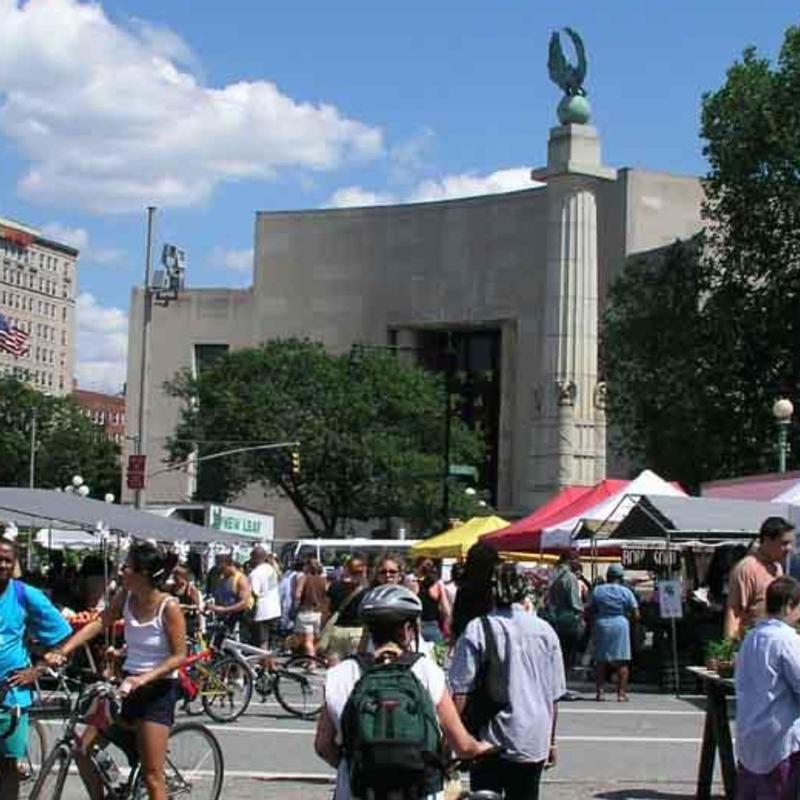
Mayor Mamdani announced plans this week to expand the pedestrian corridor of the notoriously chaotic Grand Army Plaza. Liam Quigley, parks & sanitation reporter for Gothamist and WNYC, unpacks the latest announcement, plus digs into the city-wide decline in composting.
Photo: A market at Grand Army Plaza pictured in 2003. (Credit: Alex756 via Wikimedia Commons CC 3.0)
Transcript
Title: A Pedestrian-Friendly Grand Army Plaza?
[music]
Kousha Navidar: It’s The Brian Lehrer Show on WNYC. I’m Kousha Navidar, filling in for Brian. Next up, we’re going local with Gothamist and WNYC reporter, Liam Quigley. He is our parks and sanitation reporter. Naturally, listeners, we’ve got one park story for you, and we’ve got one sanitation story for you. In sanitation news, we’ll unpack why we, as a city, are not composting as much as we were last year. That’ll be towards the end of the segment, but first, we’re talking parks. There’s been a lot of buzz recently about one of the most chaotic intersections in Brooklyn, maybe all of New York City. I don’t know, I start most of my jogs there, so I may be biased, but we’re talking about Grand Army Plaza.
Earlier this week, Mayor Mamdani announced plans to ban cars from the southern side of the notoriously dangerous roundabout. Right now, the Soldiers and Sailors Memorial Arch stands on a kind of island in the middle of Grand Army Plaza. The hope is to expand the pedestrian-only area from the entrance of the park, all the way to the arch. That’ll mean saying goodbye to the maze-like collection of crosswalks and bike lanes and six-lane traffic that separates the actual entrance of the park from the symbolic entrance. Again, we’ve got Liam Quigley, parks and sanitation reporter at Gothamist, WNYC, here in the studio to talk first about the new big plans for Grand Army Plaza. Liam, so great, always great to hang out with you and talk to you. Welcome.
Liam Quigley: Hello. Good to see you.
Kousha Navidar: First, Grand Army Plaza, a deeply stressful intersection, if you can hear it from my own voice, as most Brooklynites can attest. Can you lay out what’s so dangerous about the plaza right now?
Liam Quigley: Yes, this is a big expanse of crosswalk that every light cycle becomes a mess of drivers plowing their way through to get to Southern Brooklyn, to get on Eastern Parkway. Every light cycle, you have a convergence of people scurrying out of the way to let the cars get through there. I was there yesterday evening, and it seems like every light cycle, somebody realizes they’re too far to the right to get on Eastern Parkway, somebody’s too far to the left to get on Flatbush, and you have these conflicts. That’s the situation as it is now, and as it has been for a long time.
Kousha Navidar: Yes, it’s like a very dangerous Frogger, but real life and quite dangerous. What’s the mayor’s redesign plan for that roundabout? What would it look like?
Liam Quigley: Mamdani’s basically picking up off the shelf something that was conceived of or at least presented most recently to the public during the Adams administration. It’s probably the most aggressive of three potential redesigns that are going to– This is the one that says, “Okay, no more cars are going to go in that chaotic crosswalk. Instead, traffic’s going to be rerouted in both directions along either side of the arch.” Drivers can still go where they want to go. They just won’t be flowing through that space between the park and the arch.
Kousha Navidar: They’re making the transportation choice of going to either side earlier, before the park itself, you’re saying, at the arch before the entrance to Prospect Park?
Liam Quigley: Yes. That’s accomplished by making traffic bi-directional, rather than right now, just one side, it’s all going south. One side, it’s all going north.
Kousha Navidar: Got it. Listeners, help us report this story. If you spend a lot of time around Grand Army Plaza as a pedestrian or as a driver, what do you think of the mayor’s plans? What do you think a redesign should look like? Maybe you’re worried about what the construction process might be like, or are you excited? Do you think anything needs to change at all? Either way, we’d love to hear your thoughts. You can call us, you can text us. The number is 212-433-9692. That’s 212-433-WNYC.
Liam, I’m so happy that, in the beginning, you mentioned that this plan actually comes from before Mamdani, because I think there’s important backstory here. Advocates have been pushing for changes to Grand Army Plaza for a long time, and the Department of Transportation, like you said, actually drew up this plan under the Adams administration, so what’s been the holdup?
Liam Quigley: Look, Adams, during the Adams administration, it’s not as if there were not bus lanes getting built, there were not bike lanes getting built, but there were some things that gathered a little bit of dust and didn’t move as quickly as transportation advocates wanted him to. It’s another one of Mamdani saying, “All right, let’s hit play on that,” like the McGuinness Boulevard bike lane, or a bike lane in Queens, that’s getting advanced. If you want to go way back, the park’s designers had conceived of this being the entrance to the park, this arch.
Kousha Navidar: Originally.
Liam Quigley: Yes. It’s decades that people have been talking about like, “Let’s bring the arch–”
Kousha Navidar: Oh, wow.
Liam Quigley: They like to say, “Bring the arch into the park.” Really, this notion is not new to the Adams administration, but those plans were advanced under Adams, to some degree.
Kousha Navidar: You’re saying, and forgive the pun unless you think it’s funny, in which case you’re welcome, but they kind of ran out of gas, are you saying? The plan?
Liam Quigley: The whole Adams and his relationship to the Transportation Department is– Remember, one of his top advisors was arrested in connection with a alleged scheme having to do with hitting pause on a bike lane. At the same time, he did get some bike lanes built. It’s complicated.
Kousha Navidar: It’s complicated. Okay. Listeners, help us report this story. What do you think about the plans? I’m fascinated. I didn’t know that the plans to change the traffic, or not even change, but these are part of the original plans for the park, to have the arch come into the park. Listeners, what do you think? If you’re a biker, if you’re a driver, if you’re a pedestrian, are you worried about the construction? Are you excited? Give us a call, send us a text. 212-433-9692. Liam, let’s go to Mamdani now. What did he actually announce that’s going to push these plans forward? You wrote they didn’t have a specific timeline or budget. Are there concrete promises?
Liam Quigley: The promise is that they’ve selected this design. When and how exactly? There’ll be community outreach sessions where Transportation officials are going to look for feedback, fine-tuning, and certainly, there’s been reports of people who are concerned about the knock-on effect of is this going to throw a bunch of congestion onto my block? What if I live on, I don’t know, Sterling or 5th Ave, or any number of streets around the area? Those people are expressing those concerns. That’s definitely something we’re listening to.
Kousha Navidar: Can you talk about the budget process as well? The city has a pretty big budget deficit that the mayor is trying to resolve right now, and we’ve been talking about that on the show in greater depth. We’ll definitely keep having those conversations, but I guess more narrowly, for this segment, while we’ve got you, Liam, how does the city’s budget negotiations relate to the project?
Liam Quigley: I haven’t seen a dollar figure attached to this project yet. Though it doesn’t involve the– a bike lane will still continue through the place where the crosswalk is going to be turned into just pedestrian-only, but they’re not building anything huge, as far as I know. It’s mostly a reconfiguration. I don’t know the dollar figure.
Kousha Navidar: Okay. In terms of actually building new pieces, it’s not so much that it’s a strategic change in traffic flow-
Liam Quigley: To me, from what I’ve seen-
Kousha Navidar:-potentially?
Liam Quigley:-it looked like paint and restructuring some bike lanes, but not a huge infrastructure project by any means.
Kousha Navidar: Got it. That’s very important to think about. Let’s go to a caller. We’ve got Max in Brooklyn. Hey, Max, welcome to the show. What do you think about this Grand Army Plaza redesign?
Max: Hey, thanks so much. Yes, I moved to Park Place, just three blocks from Grand Army Plaza, last year. I’m just curious. If and when this change happens, if I’m understanding correctly, create a large pedestrian plaza. I think you may have just answered the question with saying it’s not going to be a big infrastructure thing, but has there been any reporting or talking about what potential things could fill that space? An expansion of the farmers’ market, a bathroom, anything like that in this new plaza that might get developed?
Kousha Navidar: Thanks a lot, Max, for that question. What do you think, Liam?
Liam Quigley: Yes, there is going to be an addition of public space. Transportation officials say it’s going to create 34,000 square feet of public space. The Prospect Park Alliance says they’re excited about the project. I think it’s certainly on the table to see. They said they want to do all kinds of new programming in that space. Right now, sometimes you’ll see the farmers’ market will overflow to under the arch. Totally, I think, it’s possible that you’ll see new uses for this space that include the farmers’ market and other things like that.
Kousha Navidar: Max, thanks a lot for that question. We got another caller I’d be interested in hearing from. Let’s go to Jen in Park Slope. Hi, Jen. Welcome to the show.
Jen: Hi, thanks for taking my call. I’m actually in Prospect Park right now, and there’s construction going on, which is a whole other issue about them tearing down the Vale of Cashmere. I live on 8th Avenue, around Garfield. The traffic going along 8th Avenue from the BQE and the Prospect Park Expressway, where people are using 8th Avenue as a corridor to get to Eastern and up until Union Street, is a daily parking lot of honking, of ambulances stuck in traffic, of people revving their motorcycles. It’s a horrible quality-of-life issue. I’m so worried that this redesign is going to make it even worse.
I don’t know if the reporter has any information about what’s going to happen to the through streets coming up to it, but I’m really worried. It would be great if they could improve the approach streets. I also hope they don’t just pave over this whole area, so it’s another blank concrete expanse like we have now.
Kousha Navidar: Right. Jen, I totally hear you, and thank you for calling from Prospect Park. It’s the most local that we could get right now. Liam, what do you think about that, that through street question that Jen has?
Liam Quigley: The Transportation Department says they’ve looked at traffic volumes in performing some of the analysis of how this might work, and they’re still looking for feedback. I definitely hear that concern of, yes, “What if this adds congestion to my block?” They have said the drivers who want to get where they need to go can still get there in this redesign. It’ll just be directed in the opposite direction. They used to go around the arch in some cases, but definitely look out for chances to at least share your feedback with the Transportation Department on this.
Kousha Navidar: Let’s go to Abraham as well in Prospect Heights. Abraham, hey, it sounds like you support the plaza redesign?
Abraham: I do. Thank you for having me. Longtime listener. I recently moved in the fall to Prospect Heights. I’m on Park Place, very close to Grand Army Plaza. Every morning, I get up and go for a walk in Prospect Park. Right now, having to navigate from Vanderbilt Avenue through the traffic circle is just incredibly treacherous. I’m very excited about this redesign. I think a thing that really needs to be emphasized is that because so much of the traffic in that circle is mostly Flatbush Avenue, just continuing through, the current configuration isn’t exactly workable from a traffic standpoint, either. In addition to the dangers to pedestrians, the harm to it as a public space right now, having to deal with the traffic and the arch being cut off from the park. That’s my point of view.
Kousha Navidar: Thank you so much, Abraham. Liam, any reflections on Abraham’s perspective?
Liam Quigley: On a busy Saturday, you can see people going between the library there at the plaza. I think that’s the best example of you’re kind of on this island. It can get very congested, and then boom, the light changes, and the traffic is racing through that pathway to go down Flatbush. This plan proposes to eliminate some of those treacherous crossings.
Kousha Navidar: I’m thinking also, and Abraham, first, thank you for the call, and all the callers. We love seeing all the texts and calls come in. I’m thinking about the challenge of balancing, Liam, the “I’m going to listen to everybody” perspective of the mayor versus getting things done and hitting the bureaucracy the way that it needs to, to get these plans forward, because the mayor has really positioned himself as someone who takes community feedback very seriously. How do you think he’s going to balance that commitment of being an “I get things done mayor” with the reality that this stuff can really be bureaucratically cumbersome?
Liam Quigley: Not to stray too off topic, but just as we’re speaking, Mamdani is announcing a big expansion of the Empire Bins, those trash bins that are in some parking spots. They’re replacing some parking spots. He’s saying that it could take up to 6,500 of those bins across the city. In his release, he’s saying we deserve a clean city with no trash bags. You’re talking about parking. That’s something that a lot of mayors are scared to touch. I think, look, he’s saying this needs to be safe, and we’re going to do it.
Kousha Navidar: Yes. You are listening to The Brian Lehrer Show on WNYC. I am Kousha Navidar. I’m a host here at WNYC. Very happy to be with you today. Listeners, thank you so much for talking about Grand Army Plaza. I’m sure more of this is going to unfold over the coming weeks and months. We’ll be sure to cover it, but we’ve got someone here who has at least two beats. I do want to get to some of the latest sanitation news before we run out of time.
Quick recap here. One of the signature initiatives of the Adams administration was the so-called trash revolution. He made sweeping efforts to put New York’s trash in containers, but another part of that trash revolution was composting, the intro of a composting program. That program seemed to be taking off until about a year ago, when the city stopped issuing fines to landlords who weren’t complying with the new protocols. Landlords have basically stopped putting out compost after the fines stopped coming. At least that’s what it feels like.
The Mamdani administration has said that they’re bringing back enforcement measures. Liam, you’ve reported that we haven’t quite bounced back, so let’s get into it. Tell me about your latest reporting. What does the data tell us about how many people are actually composting?
Liam Quigley: This report originally came from the city’s Independent Budget Office who they broke down what the effect the fines had last April when those fines hit buildings who were not participating in the city’s mandatory curbside compost collection, which was the first time under Adams that we’ve had a citywide composting program. Everyone in the city is supposed to be doing it. They said, “All right, we gave you a chance. Now, if you don’t do it, just like if you don’t recycle, we’re going to send inspectors who are going to look through your trash bag or find some other evidence that you’re not separating your chicken bones and your pizza crusts, and we’re going to start issuing the owner of that building a fine.”
Kousha Navidar: Physically go through the trash?
Liam Quigley: If they have to.
Kousha Navidar: Wow.
Liam Quigley: They were doing that. Bunch of fines, hundreds a day. Then Randy Mastro, who had a lot of power at that point, basically hit pause. We reported at the time last year, the IBO found, the Independent Budget Office found that participation in the program that had been climbing as those fines were hitting, dropped off and didn’t recover through the end of last year. That’s the effect that the fines that they’re saying had on people, saying, “All right, I guess we have to do this composting thing.”
Kousha Navidar: Yes, but there is data, you’re saying, that the composting thing has fallen off? Less participation?
Liam Quigley: Yes. You can see it climbing up in April and then falling back down and staying the same, but I think there might be some good news on the horizon, because just as I was getting ready to talk to you, I looked at this week. We have 324 citations issued for failure to compost. That’s up a lot compared to a four-week rolling average. I think the Sanitation Department is turning up the volume a little bit on that enforcement.
Kousha Navidar: The enforcement, yes. Listeners, we want to let you know that we’re talking about compost right now. Do you compost? I’m very interested to hear how folks, especially in large apartment buildings, are experiencing composting. Is your building providing an easy way for you to do it? The phones are also open to landlords who want to share how you’re approaching the new compost requirements. What’s been working about the program? What hasn’t? What are you hoping for going forward? Give us a call, send us a text. We’re at 212-433-9692. That’s 212-433-WNYC. We are talking about composting with Liam Quigley.
Liam, I’m curious about the distinction between landlords and tenants when it comes to who is responsible for composting. The landlords are the ones getting fined, but they’re ultimately the ones forgetting– They’re not forgetting to put their onion peels in the compost bin. How does that play out on an administrative level when you’re talking about going through looking at garbage?
Liam Quigley: The same way. Let’s say I own a small building in Sunnyside, Queens, and I also have a day job. Then my super is not working today, and then someone leaves a Snickers wrapper on my sidewalk, a Sanitation official can still come and ticket me for that.
Kousha Navidar: For the Snickers wrap– Oh, yes. Okay.
Liam Quigley: It’s an extreme example, but that’s how this works. Building owners need to provide a mechanism by which their tenants can participate in this program. If they don’t, tenants can call 311, and they’ll start with education and say, “Hey, here’s how you do this. Same way you recycle. You need to provide a receptacle, a way for tenants to follow the law.”
Kousha Navidar: We just got a text I want to read. It says, “Our building in Prospect Park South has nearly 100 units, and there is one small bin only, and they don’t even properly set it out for pickup. Building management leaves it in a black trash bag and put it out with the rest of the trash because they don’t care, and there’s literally nothing I can do. I’ve tried everything with the city, and there are no repercussions.” Although, Liam, you’re saying it looks like there’s an uptick in some of those repercussions. How often do you hear that from folks, about, like, “Hey, I want to do it, but it’s like one thing for 100 units. What am I supposed to do?”
Liam Quigley: Yes, I hear that. “My building does not offer a mechanism for me to compost. I’d like to try it.” You can call 311. You can bring your building and your landlord to the attention of the Sanitation Department, who can issue a series of escalating fines to try to bring your landlord into compliance to talk to your super, whoever, to make this happen. Is that going to fix it? I don’t know. What’s the recycling rate in New York City? I don’t think it’s above 50% of all recyclable material, and that program has been around for decades. It’s tough.
It’s definitely easier if you’re in a one or two-family home. That’s why we see higher composting rates in parts of Queens with lots of one and two-family homes. You’ll see all those little brown bins all lined up on compost collection day.
Kousha Navidar: There is another text that we just got in that I’d love to read that relates to this. It says, “Avid composter here. Can they simply reliably collect the compost? It’s frustrating when the trash and recycling are picked up, but the compost bins are left sitting at the curb until last.” This is from Pat in Brooklyn Heights. It sounds like Pat has an issue with actual pickup of it. Have you heard anything about that from folks that you talk to?
Liam Quigley: I look at the missed collection 311 requests. I don’t know about compost specifically. Those are down this year. Obviously, like this week, you’ll get 500 people saying, “My collection was missed.” That’s another 311 thing, say, “The compost was not picked up.” From my impression of Sanitation, they’re usually fairly responsive to that, but feel free to contact us if that’s something that’s an ongoing issue.
Kousha Navidar: Let’s go to Bill in Queens. Hey, Bill. Welcome to the show.
Bill: Hi. Longtime listener, first-time caller.
Kousha Navidar: Welcome.
Bill: Thank you. I’m in the unenviable position of being the president of our cooperative, Mainstay Section 1 in Kew Gardens Hills by Queens College. I am happy to report that in one of our buildings, we have four composting bins that we put out every week, and the other building, we have two. It requires a commitment on the part of the cooperators, requires a commitment on the part of the board, and, of course, the building staffs, 32BJ, need to do their part. We try to publicize the composting. We, of course, remind people the building can be fined, but we also try to promote that the main reason to compost is to divert these organics from the landfill and to help the parks department build new soil. We try to appeal to people on both sides.
Kousha Navidar: Bill, thank you so much for that call. It’s interesting to hear your perspective as the president of a coop. It leads me to want to hear from a landlord as well. It looks like we have one on the line. John, from Brooklyn. Hey, John, welcome to the show.
John: Thank you very much. I’m not driving. I pulled over.
Kousha Navidar: Thank you. Appreciate that. Hopefully not in Prospect Park right now, as we were talking about. Sorry, go ahead.
John: No. Your guest said one thing that’s accurate, that it’s easier for a one or two-family homeowner to do. I happen to be a two-family homeowner, but I also happen to be a landlord of many buildings. It’s just really disappointing how people, like your guests, just don’t get the burden that they’re placing on landlords and the expectations. I have a 16-family building that. That doesn’t mean there’s 16 people. Everyone’s married or has a partner, so there’s 32 people. How are you supposed to go through everyone’s garbage and sort out for food? We put compost bins. Sometimes, they don’t put it in. The tenant doesn’t get the fine. The landlord gets it.
Then you have to increase building staff to do all of this. The supers don’t want to do it. They tell you to your face, “I don’t want to do it.” It’s very, very frustrating. There’s no outreach to landlords. If I understood your guest correctly, I’m not trying to insult them, but it sounded like he was celebrating that the fines have gone up. To me, that’s appalling. You should be helping landlords cooperate, not just sticking us with fines. Thank you.
Kousha Navidar: John, let me ask you a follow-up. Thanks. I really appreciate you coming on, and I can hear the frustration. I’m wondering what would help you do the job? I’m thinking, for that 60-family building that you’re talking about. You mentioned outreach. Is it that? What would that look like? Something different? Tell me.
John: Yes. Outreach, get suggestions on how it could be implemented better. It was just crammed down our throat. What are you supposed to do if tenants don’t cooperate? If you, as the owner, put out the bins, put out signs, send out notices to every tenant, and they don’t do it, it’s unfair that the landlord gets the hit. I would have to hire more people to go through everyone’s garbage, and they don’t want to do it. I will openly tell you, I don’t care if they throw it in the garbage because that’s the position that I’ve been put in. Now, in my own house, I have a two-family house. I compost, and so does my tenant, because it’s more manageable.
What about people that have 50 family buildings, 30 family buildings? Will the Department of Sanitation subsidize our overhead for hiring more people for buying gloves to go through people’s garbage? It’s like there’s no thought or there is thought, but no one cares because there’s more tenants than landlords in New York City. It’s disgusting.
Kousha Navidar: John, I really appreciate you calling in and giving us your perspective and pulling over while you were driving to talk about how it is for you as an owner of large family homes. Liam, I’m sure that you’ve heard this kind of feedback from landlords. How does it resonate with you? What efforts could the administration do to make it easier for landlords like John, who actually composts in his own home, do the job?
Liam Quigley: I think in the view of the Sanitation Department, it is the responsibility of property owners to ensure that their buildings, and therefore, the refuse that is set out at the curb is in compliance with the rules. Certainly, it’s a challenge. You can have a tenant who is not recycling, is not composting. Yes, it is a high-touch situation where you have to have intervention by building staff, but the Sanitation Department has done a renewed PSA campaign with Scrappy, the brown compost bin, to try to promote composting. The fines are still a fraction of what they were last April under Eric Adams.
I am getting the sense they’re going to go up, and they have gone up, but it’s still a fraction of the fines that were being issued last year, when the report found that it actually increased composting rates. That’s what the IBO found, is saying, “If you turn up the volume on the fines, you’re likely to see an increase in capture rates,” which is the amount of people composting. That being said, I did talk to experts who said there does need to be a big education lift here. We don’t necessarily want to lead with fines, and the Sanitation Department has said that, too. They said it’s one tool of their toolbox in increasing composting rates.
Kousha Navidar: That’s all the time we have. I just want to remind listeners that the DOT is hosting public workshops to get feedback on the Grand Army Plaza redesign on Thursday, April 23rd, and Saturday, April 25th. You can submit your feedback online. We’ve been here with Liam Quigley. Liam, thank you so much for talking to us both about the Grand Army Plaza and composting. Really appreciate it.
Liam Quigley: Thank you.
Copyright © 2026 New York Public Radio. All rights reserved. Visit our website terms of use at www.wnyc.org for further information.
New York Public Radio transcripts are created on a rush deadline, often by contractors. This text may not be in its final form and may be updated or revised in the future. Accuracy and availability may vary. The authoritative record of New York Public Radio’s programming is the audio record.
Queue