"Reimagining Grand Army Plaza" — The Stuyvesant Spectator
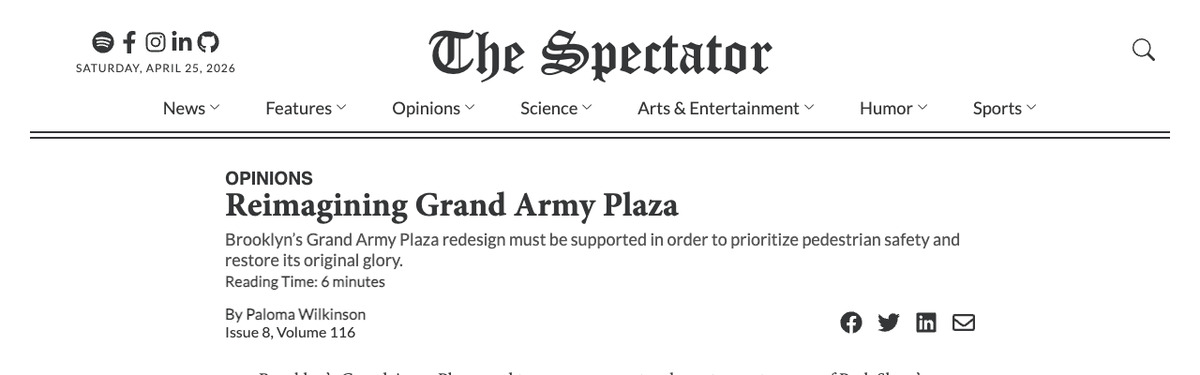
Paloma Wilkinson, writing in The Stuyvesant Spectator, makes a clear and well-sourced case for the redesign — starting from the very beginning.
“Brooklyn’s Grand Army Plaza used to serve as a spectacular entrance to some of Park Slope’s greatest institutions: Prospect Park, the Central Branch of the Brooklyn Public Library, and the Botanic Garden. But today, it is a highway disguised as a roundabout, overrun with traffic and disorienting crosswalks.”
On the current pedestrian experience:
“Anyone who’s ever waited on one of its asphalt islands knows the drill: check the walk signal, realize the walk signal means nothing, sprint, and hope no car swings a left turn into you.”
The piece traces the plaza’s history from Olmsted and Vaux’s 1867 vision through the car takeover of the early 20th century, citing the 1927 “Death-O-Meter” — a sign Brooklyn authorities installed to track traffic injuries and fatalities at the plaza. Nearly a century later, the numbers are still bad: 139 injuries in the past decade, plus 206 additional crashes between 2017 and 2021 that didn’t cause injuries.
Wilkinson draws on precedents like Washington Square Park (road closed to traffic in 1963) and Columbus Circle (redesigned in 2005) — both of which went through the same debate before becoming the public spaces New Yorkers now take for granted.
“Grand Army Plaza is stitched into my everyday life. It’s part of my walk to the park, trips to the library, and every weekend market run. This is why the DOT’s redesign isn’t just some policy idea, it’s about whether I can safely cross the street to reach institutions that are supposed to serve my neighborhood.”
Read the full piece at The Stuyvesant Spectator →
Read the plan → · Sign our petition →