The Plan
Mayor Mamdani backed the redesign in April 2026. Help turn that commitment into a built plaza.
Mayor Mamdani Backs the Redesign
On April 13, 2026, Mayor Mamdani announced a proposal to connect the Soldiers’ & Sailors’ Memorial Arch to Prospect Park by eliminating the dangerous stretch of road between them — the pedestrian plaza the community has demanded for twenty years.
“Grand Army Plaza is the gateway to Brooklyn’s backyard, Prospect Park — and it should welcome New Yorkers with street design that puts safety first. Anyone who’s tried to cross here knows how dangerous and chaotic the streets can be.” — Mayor Zohran Mamdani
The redesign will add three-quarters of an acre of new public space (a 42% expansion), cut pedestrian crossings from 39 to 24, upgrade bike lanes, and speed up the B41 bus — Brooklyn’s busiest, with 27,300 daily riders. DOT Commissioner Mike Flynn, who was part of the original 2006 coalition as a young advocate, called it “the next big step to create a public space all of Brooklyn will be proud of.”
“Every time NYC DOT has provided more space to pedestrians at the park, it’s been an instant success, and it becomes impossible to think of how the space could have functioned before.” — DOT Commissioner Mike Flynn
“This is a major step forward for everyone who visits Brooklyn’s backyard, and a restoration of Olmsted’s original vision for his favorite park.” — Ben Furnas, Transportation Alternatives
NYC DOT’s own injury summary counts 219 traffic injuries along the plaza’s roadways between 2020 and 2025, while the study stalled under the Adams administration. The mayor’s backing brought progress: DOT held public workshops in April and presented the study to Brooklyn Community Boards 6, 7, 8, 9, and 14 on June 2, 2026.
The June 2026 DOT deck confirms the redesign would add 42% more public space and shows the community’s plaza-concept preferences: Open Axis 40% and Diagonal Grove 36% (the two green, tree-canopy-forward options), with Radial at 11% — based on 1,057 conclusion-outreach respondents.
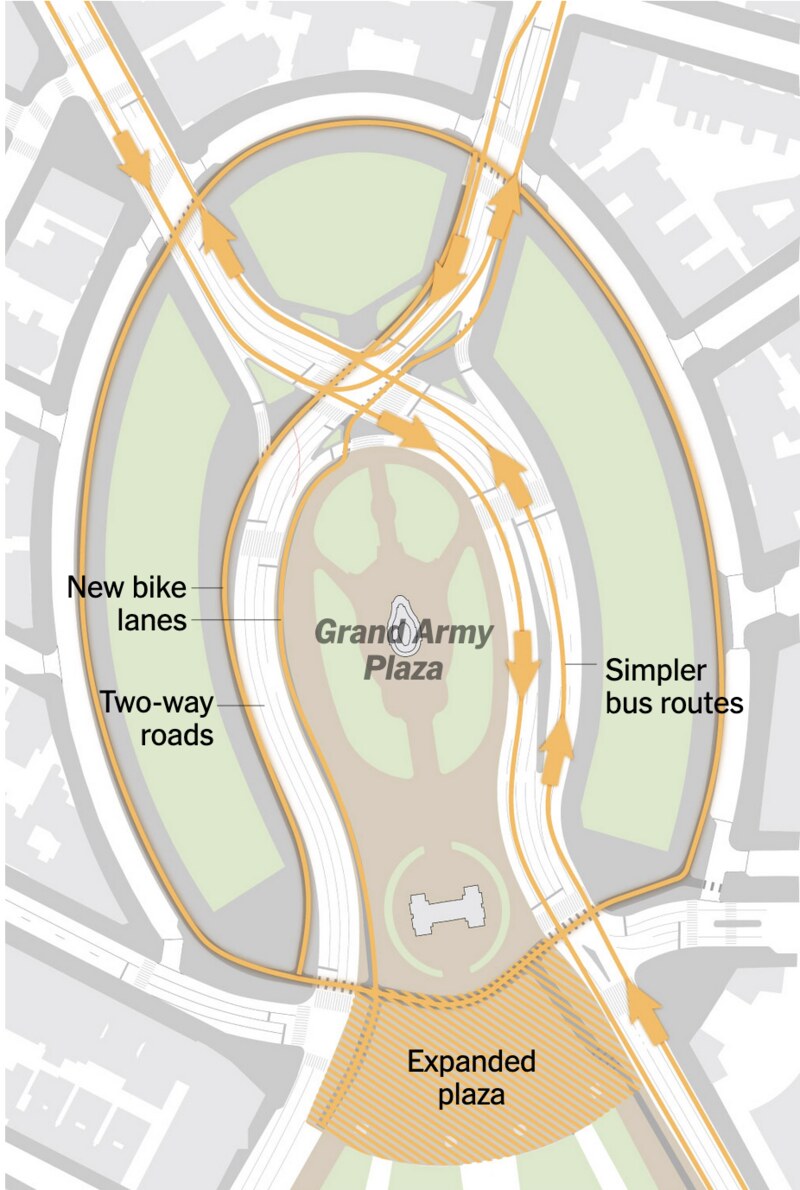 The New York Times broke down exactly what changes for pedestrians, cyclists, bus riders, and drivers — fewer crossings, raised crosswalks, protected bike lanes, simpler bus routes. Graphic: The New York Times / NYC DOT
Official DOT Documents
These are the primary sources for the study NYC DOT began in 2022. See the DOT Grand Army Plaza project page for agency updates.
-
Community Update — June 2026 (PDF) ⭐ — 48-page deck DOT presented to Brooklyn CBs 6, 7, 8, 9, and 14. Includes the 42% public-space figure, plaza-concept survey results (Open Axis 40%, Diagonal Grove 36%), and a Future Considerations section addressing community concerns
-
Design Update Boards — April 2026 (PDF) — Earlier design concept with updated data, plaza concepts, and community feedback results
-
Workshop Materials — April 2026 (PDF) — Detailed vehicle flow analysis for Union St, Flatbush, Eastern Pkwy, and Vanderbilt
-
Community Update — April 2024 (PDF) — Overview of the CPSD study and the design concepts, including Option B: “Unified Public Spaces”
-
Workshop Boards — June 2024 (PDF) — Detailed diagrams showing pedestrian volumes, bike routes, bus operations, and the design options
-
Workshop Summary — November 2022 (PDF) — First-round community feedback showing majority interest in unifying public spaces
-
DOT Current Projects Index — All Grand Army Plaza documents in one place
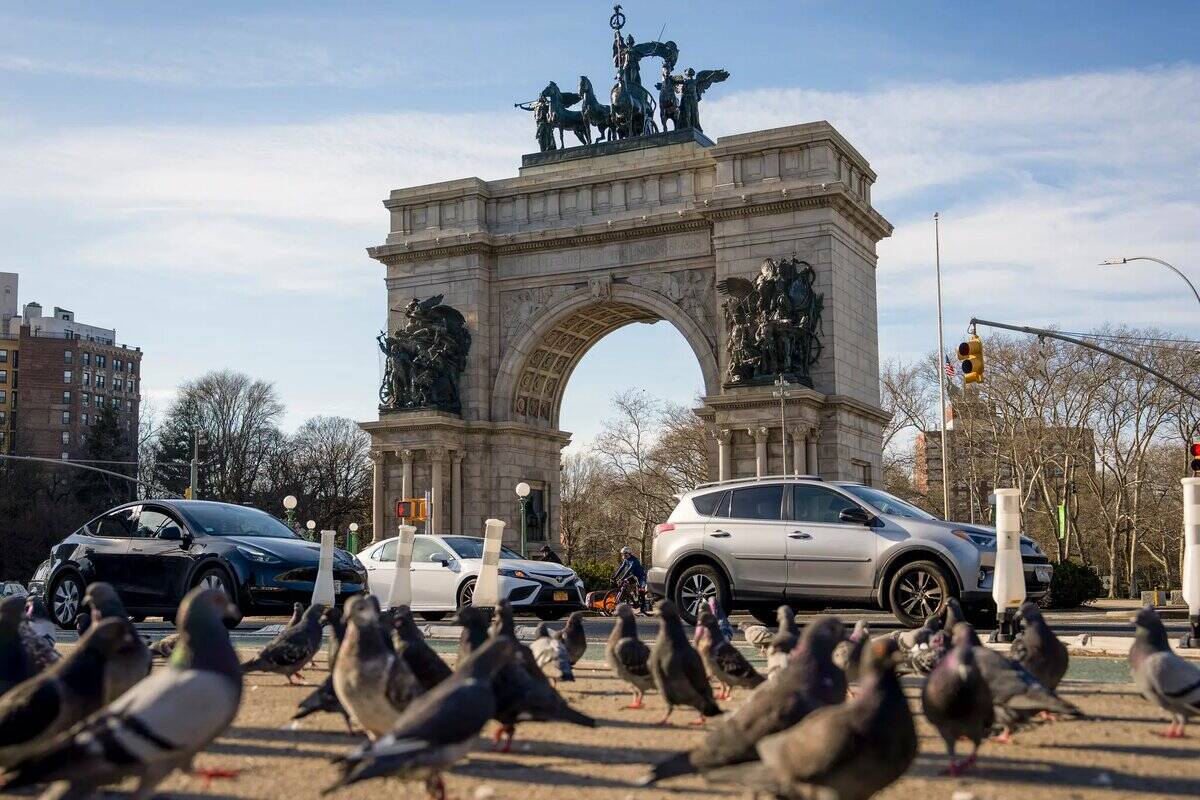 Grand Army Plaza today: cars, pigeons, and a lot of wasted space. Photo: The New York Times
The CPSD Study
NYC DOT and DDC’s $1.8 million Conceptual/Preliminary/Schematic Design (CPSD) study developed proposals for Grand Army Plaza and nearby corridors. The mayor-backed redesign grew out of Option B: “Unified Public Spaces”.
The campaign is pushing to carry that work into a funded capital project. Design development is progress, not a construction start date.
The community has already spoken clearly — twice. At DOT’s November 2022 workshop, 88% of attendees passed over both incremental options — 60% chose the unified public space concept, and another 28% said none of the four ideas fit and a new concept should be developed. Just 5% picked building out the existing painted spaces, and 7% chose consolidating Flatbush traffic. In the survey of 2,077 people, 64.8% of the surrounding community commutes by public transit, and 87% of respondents walk to Grand Army Plaza.
In the 2024 outreach round, the numbers got even stronger: 86% chose Option B out of 1,624 survey responses, with just 12% preferring Option A and 2% choosing neither. DOT has since incorporated community feedback into the design — adding new crossings to Bailey Fountain, shortening crossings at Flatbush and Vanderbilt, creating a direct bike path to Vanderbilt Ave, and making the Plaza St bike lane parking-protected and raised.
What is Option B?
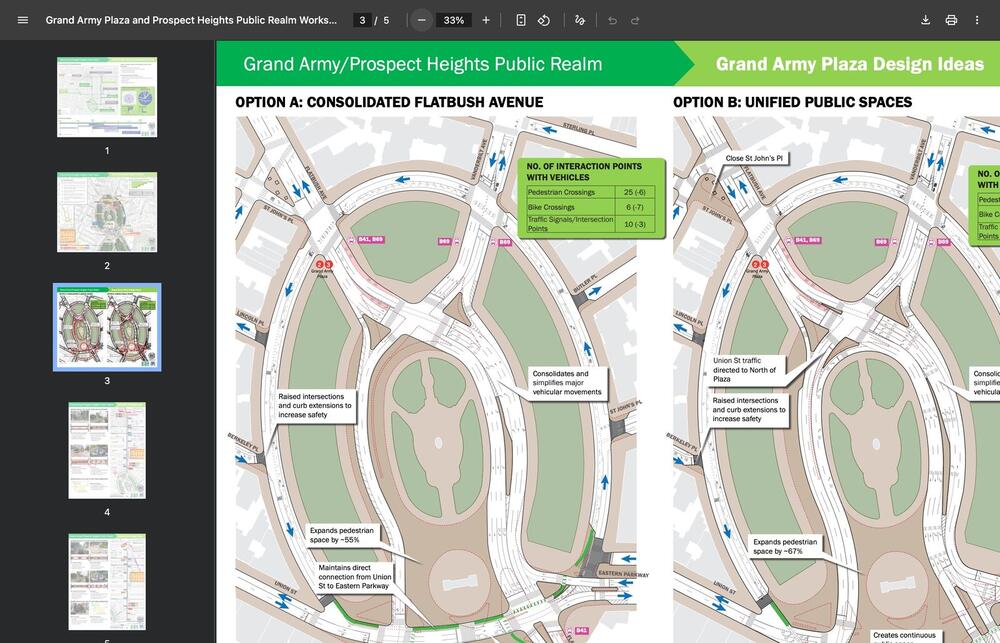 From NYC DOT Workshop Boards, June 2024
Option B — “Unified Public Spaces” would:
- Close the roadway that currently separates the Soldiers’ & Sailors’ Arch from Prospect Park
- Consolidate fragmented traffic islands into a single, contiguous pedestrian plaza
- Cut crosswalks from 24 to 12 and intersections from 11 to 3
- Increase bicycle space by 122% with a direct bike path to Vanderbilt Ave
- Reduce B41 bus delay by 41% with better stop placement and routing
- Expand public space by 42% for the Greenmarket (NYC’s 2nd largest), events, and daily life
The goal: one grand plaza connecting the Arch to the Park, instead of the confusing, car-dominated traffic circle we have today. In the morning peak hour, 3,083 pedestrians, 766 bus riders, and 350 cyclists already pass through the plaza — outnumbering the 2,831 vehicles 1.5 to 1. The redesign aligns the infrastructure with the reality.
DOT presented three design concepts for the plaza space: Radial (modern, open flexible space), Diagonal Grove (consistent tree canopy), and Open Axis (historic character, large events). All three include landscaping, seating, and programmable space for markets and gatherings.
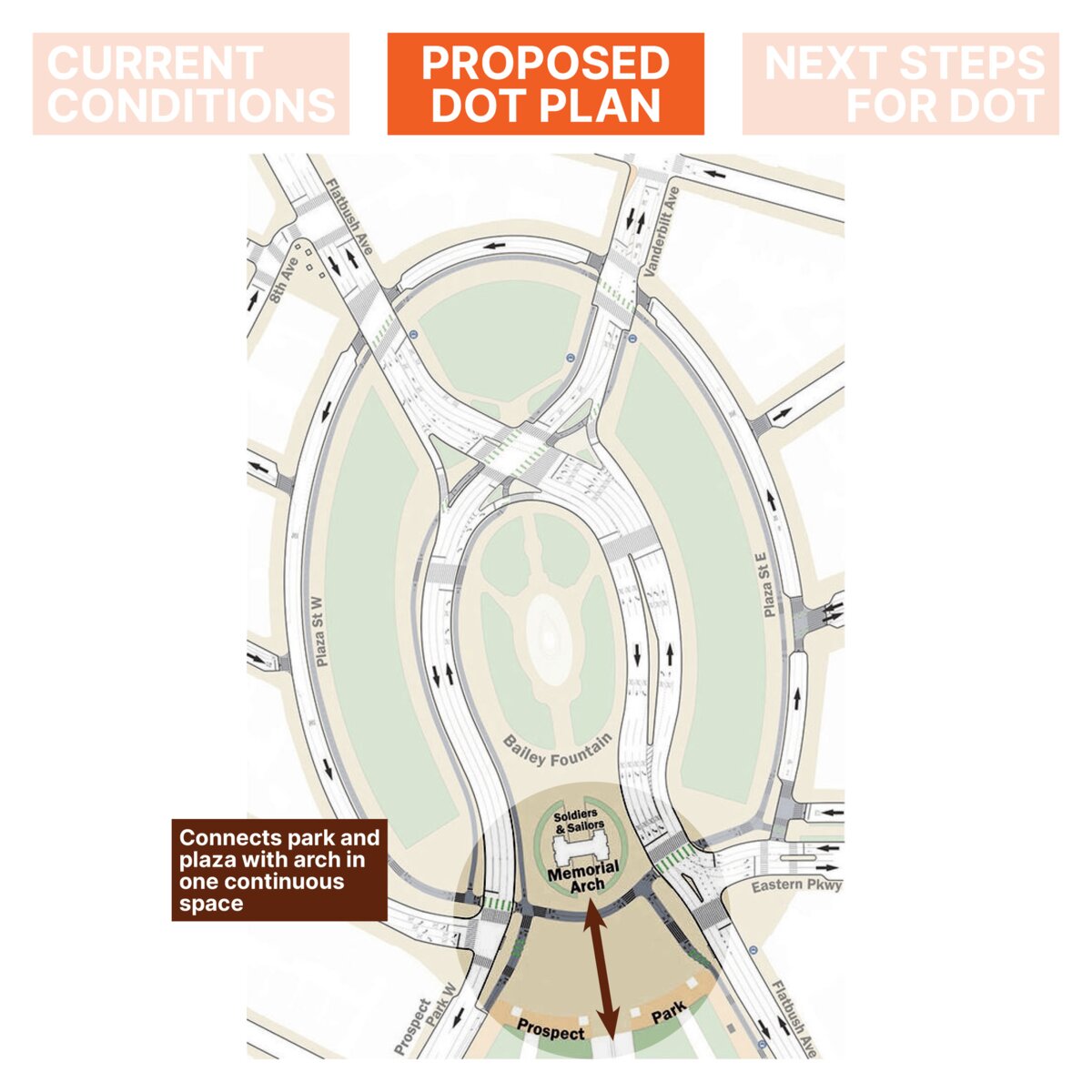 Option B connects park and plaza with the arch in one continuous space. From Transportation Alternatives
Want to see what it could feel like? A local 5th grader built a 1:1 model of the redesigned plaza — walk through it in Minecraft →
What We’re Asking For
We’re urging DOT, DDC, Community Boards 6, 8, and 9, and City Council Districts 35 and 39 to:
- Fund and build the announced redesign and publish a clear construction schedule
- Remove through-traffic between the Arch and Prospect Park
- Prioritize pedestrian safety and accessibility over vehicle throughput
- Design for daily use, not just special events
Timeline
| Phase | Status |
|---|---|
| Initial outreach and design concepts | Published 2022–2024 |
| Mayor’s backing and public workshops | April 2026 |
| Community Board 6, 7, 8, 9 & 14 presentation | Held June 2, 2026 |
| Landmarks Preservation & Public Design Commission review | Listed for summer 2026; completion unconfirmed |
| Complete CPSD study, present to OMB | Listed for summer 2026; completion unconfirmed |
| Initiate capital project, explore reconstruction options | Listed as post-study; construction date unconfirmed |
| Vanderbilt & Underhill design via AAMUP | Listed as continuing after the study |
As of November 17, 2026, we don’t have a confirmed date for the next public meeting or construction. The DOT project page still lists summer 2026 targets without confirming their completion. The mayor’s backing remains a major step forward. Help get the plaza built: sign the petition →.
History
This isn’t a new idea. The plaza has been evolving for over a century, and people have been fighting for a pedestrian-first Grand Army Plaza for twenty years.
| Year | What happened |
|---|---|
| 1873 | Majority of Prospect Park opens to the public. |
| 1892 | The Soldiers’ and Sailors’ Memorial Arch is constructed. |
| 1932 | Bailey Fountain is constructed. |
| 1989 | Greenmarket founded at Grand Army Plaza. |
| 2000 | Vehicle hours reduced in Prospect Park. |
| 2002 | Concrete triangle installed at the Public Library entrance. |
| 2004 | One-way bike lanes added to three new concrete triangles at Plaza South. |
| 2006 | Aaron Naparstek, Robert Witherwax, and neighbors form the Grand Army Plaza Coalition (GAPCO) to advocate for redesigning the plaza. |
| 2007 | The Design Trust for Public Space releases a concept plan. Streetsblog calls it “brilliantly obvious.” |
| 2008 | Design Trust for Public Space study published. |
| 2010–2012 | NYC DOT releases redesign plan; additional concrete pedestrian islands installed with plantings. |
| 2011 | Commissioner Janette Sadik-Khan implements partial changes — pedestrian islands go in, but the Plaza Street bike lane gets dropped. |
| 2012 | Two-way bike lane installed on Plaza Street. Eastern Parkway median reconstructed between Plaza and Washington. |
| 2017 | Car-free pilot begins in Prospect Park. |
| 2018 | Prospect Park becomes permanently car-free. |
| 2022 | DOT restarts the study with community workshops. 88% of 270 attendees support major redesign. Curb extensions and bike parking added to Plaza Street intersections. |
| 2022–2025 | The Adams administration stalls progress. Crashes continue on the plaza — 219 injuries were recorded over the five years ending 2025. |
| 2024 | Second round of DOT outreach. 86% of 1,624 survey respondents choose Option B. |
| 2025 | $8.9M Arch restoration completed. |
| 2026 | Mayor Mamdani embraces Option B and directs DOT to advance the pedestrian plaza. Public workshops in April; DOT presents the conceptual study to Brooklyn CBs 6, 7, 8, 9, and 14 on June 2. Conclusion-outreach survey of 1,057 respondents picks Open Axis (40%) and Diagonal Grove (36%) over Radial (11%). |
History based on NYC DOT’s official project timeline.
The difference this time: a mayor who’s publicly committed, a DOT commissioner (Mike Flynn) who was part of the original 2006 coalition as a young advocate, an active $1.8M CPSD study with budget, and twenty years of accumulated community will.
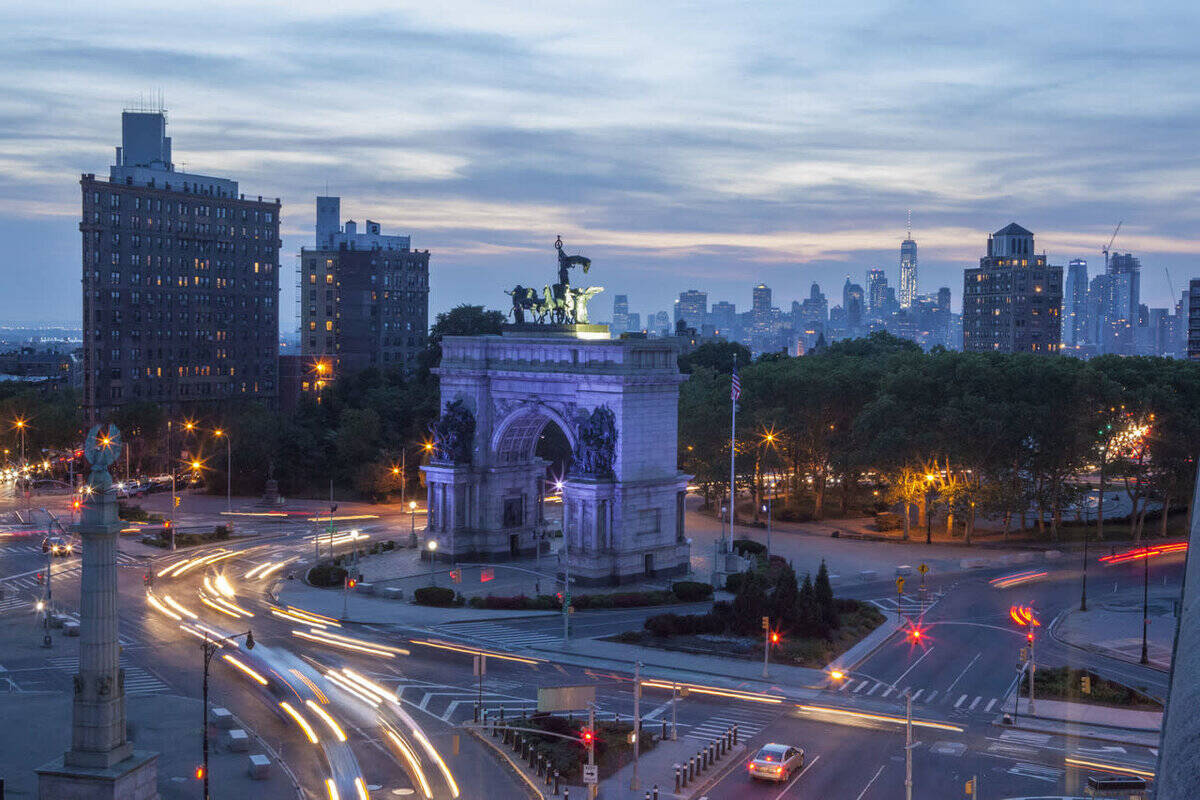 All those car headlights could be people instead. Photo: Tagger Yancey IV
Why Now
Three major public investments are converging at Grand Army Plaza for the first time:
- Arch restoration completed 2025 ($8.9M)
- Brooklyn Public Library renovation completing 2027 ($95M)
- Plaza redesign advancing 2026
This alignment won’t happen again. And the cost of waiting is real — 219 injuries were recorded on the plaza’s roadways over five years while the study stalled.
Ready to add your voice?