DOT presents the plaza study to 5 community boards — what's new
Last night DOT held a two-hour public Zoom session with Brooklyn Community Boards 6, 7, 8, 9, and 14 — 30 minutes of presentation, 30 minutes of CB Q&A, and an hour of public comment. The reaction was largely supportive, with some neighbors raising specific concerns about traffic and access on the surrounding streets. Many of those concerns are already addressed in a new “Future Considerations” section that DOT added to the deck.
The whole deck is a meaningful update on the spring outreach. Read the June 2026 deck (PDF, 48 pages) → or check the official NYC DOT Grand Army Plaza project page.
What’s new in this deck
Four findings stand out:
- The redesign would add 42% more public space between the Arch and the park entrance.
- The community has picked favorites among the three plaza concepts. Open Axis leads at 40%, Diagonal Grove close behind at 36%, Radial at 11%, and “none of these” at 13% — based on 1,057 survey responses, 66% of them from the local zip codes (11238, 11215, 11217).
- The preferred design style leans historic, not modern. 40% want to preserve the historic style; 33% want a mix of historic and modern.
- DOT directly addressed recurring concerns — 8th Ave/Union one-way conditions, the St John’s Place block, Flatbush/Vanderbilt crossings, future Flatbush bus priority, ped/bike conflicts at the park entrance, and Plaza Street curb management — in a new “Future Considerations” section.
The numbers, refreshed
The June deck shows updated peak-hour counts and outcomes for every mode using the plaza:
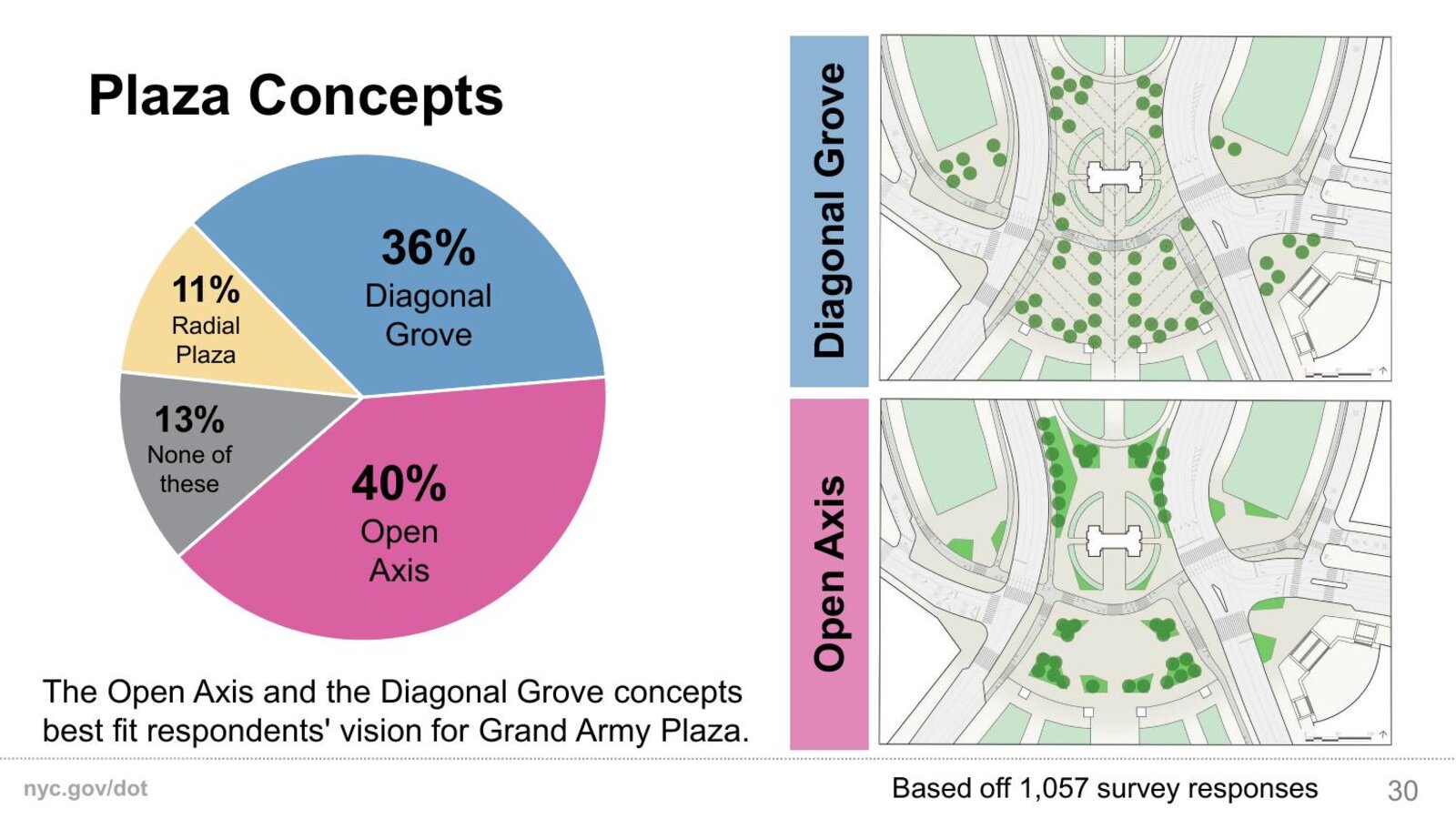
- 3,083 pedestrians in the morning peak hour. Public space increased by 42%. Max waiting time at the Library crosswalk drops from 120 seconds to 85, and the crossing changes from two stages (waiting on a triangle) to one stage with no waiting. Crosswalks reduced from 23 to 12.
- 766 bus riders in the morning peak hour (B41 Local + Limited, B69). Bus riders see a 41% decrease in travel times through the plaza. Bus stops stay in place, and Flatbush Avenue can be adapted to accommodate future Bus Priority Infrastructure south of the plaza toward Downtown Brooklyn.
- 350 cyclists in the morning peak hour. Cyclist waiting points drop from 11 intersections to 3, with a direct connection from Vanderbilt Ave to Prospect Park West and the park entrance.
- 2,831 vehicles in the morning peak hour use the roadway between the arch and the park entrance — 35% of vehicles using the entire plaza pass through that segment. For the 62% of affected vehicle trips going from Vanderbilt/Flatbush to Eastern Parkway, travel times drop by 45%. For the 38% going from Union Street to Eastern Parkway, travel times rise slightly (22%). All vehicle trips remain inside the plaza loop.
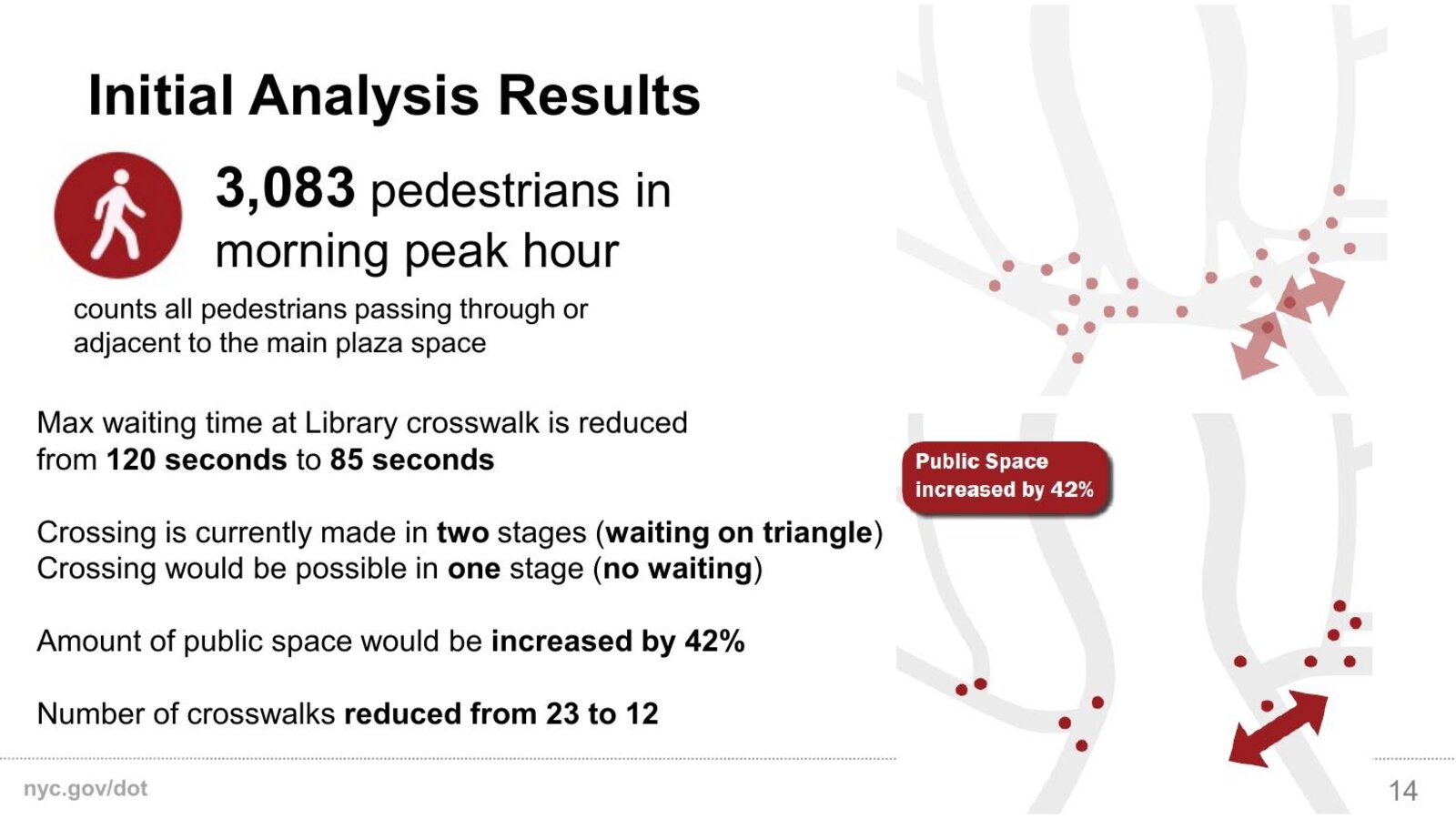
The seven post-2024 design refinements are mapped together on slide 13: new crossings to Bailey Fountain, shortened crossings at Flatbush and Vanderbilt, an accessible path on the west side of Bailey Fountain, a bike path shifted north with fewer roadway crossings, a parking-protected raised bike lane on Plaza Street, a direct bike lane from Prospect Park West to Vanderbilt Ave, and a loading zone on 8th Ave at St Johns.
The community picked a plaza concept
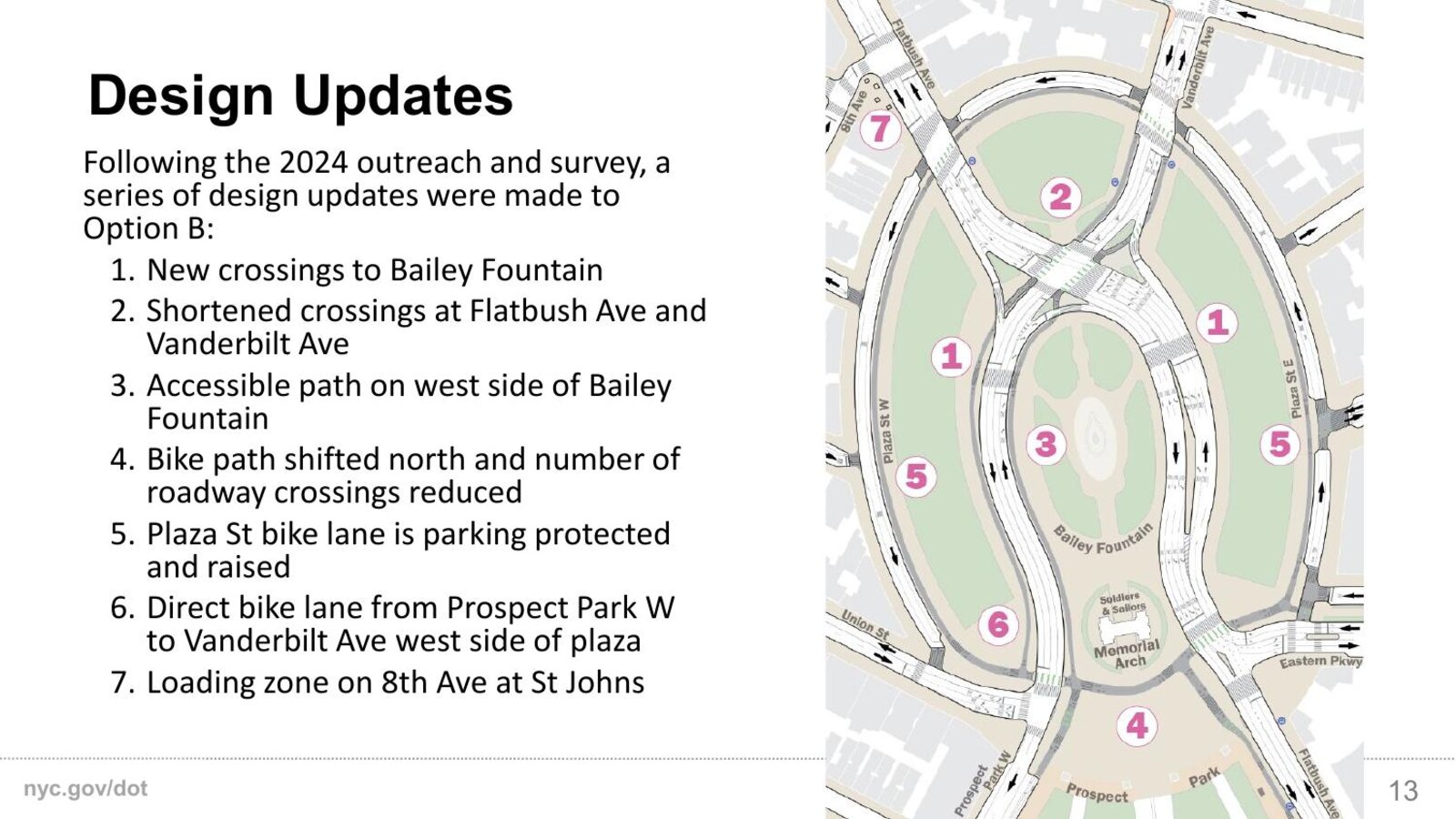
DOT is presenting three concepts for the new pedestrian space: Radial Plaza, Diagonal Grove, and Open Axis. From the deck:
- Radial Plaza reinterprets the historic oval and circular forms with concentric waves emanating from the arch. Maximizes hardscape for flexible programming. Preserves the primary view corridors from the park and Eastern Parkway to the Arch.
- Diagonal Grove is inspired by historic plaza paving and monumental civic precedents, organized as a formal tree bosque for consistent shade, with an open ground plane for events and a linear allée framing the main sight line.
- Open Axis transforms a classical spatial composition into a contemporary language responsive to the roadway geometry, with layered planting and canopy trees defining the space and extending the park-like landscape into the plaza.
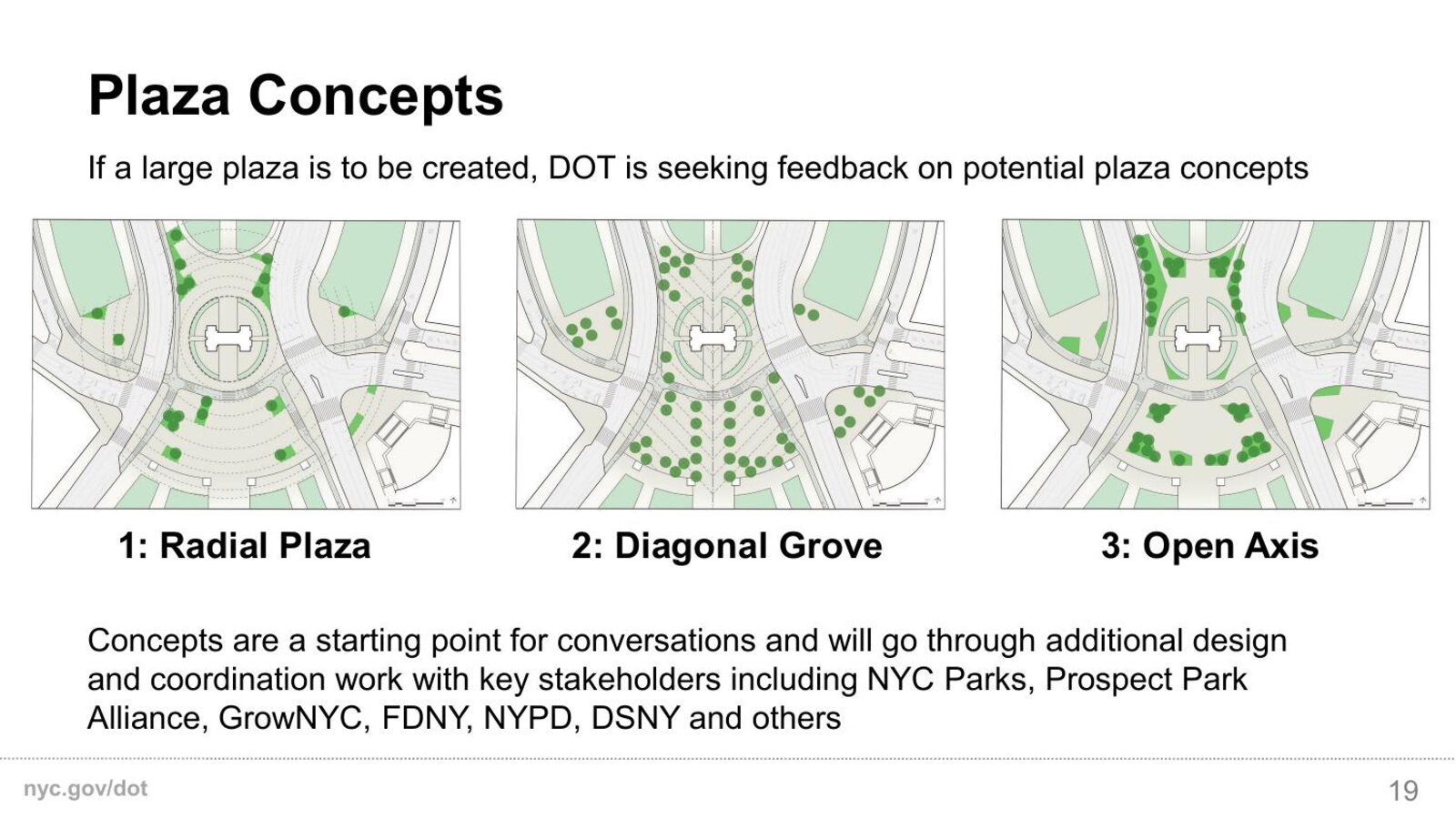
Of the 1,057 conclusion-outreach respondents, 40% chose Open Axis and 36% Diagonal Grove — the two that lean into greenery and tree canopy. Just 11% picked Radial, the most hardscape-forward option. DOT’s read: “The Open Axis and the Diagonal Grove concepts best fit respondents’ vision for Grand Army Plaza.”
The element list reinforces that direction. The most-requested plaza elements were greenery, plantings, and large canopy trees, followed by seating, tables, and benches, then shade structures, public restrooms, an open-air café, open space for events, and public art. From the respondents:
“Canopy trees are a must with the hot summers. Especially as the city heats up with climate change.”
“More seating areas scattered throughout is important.”
“I love the farmers market and would like to see it expand with more areas nearby for seating.”
Concepts will go through additional design and coordination work with NYC Parks, Prospect Park Alliance, GrowNYC, FDNY, NYPD, DSNY, and other agencies.
DOT is answering the concerns
The most notable structural addition to the deck is a new “Future Considerations” section that names six specific concerns from workshops and the survey, and commits to additional planning on each:
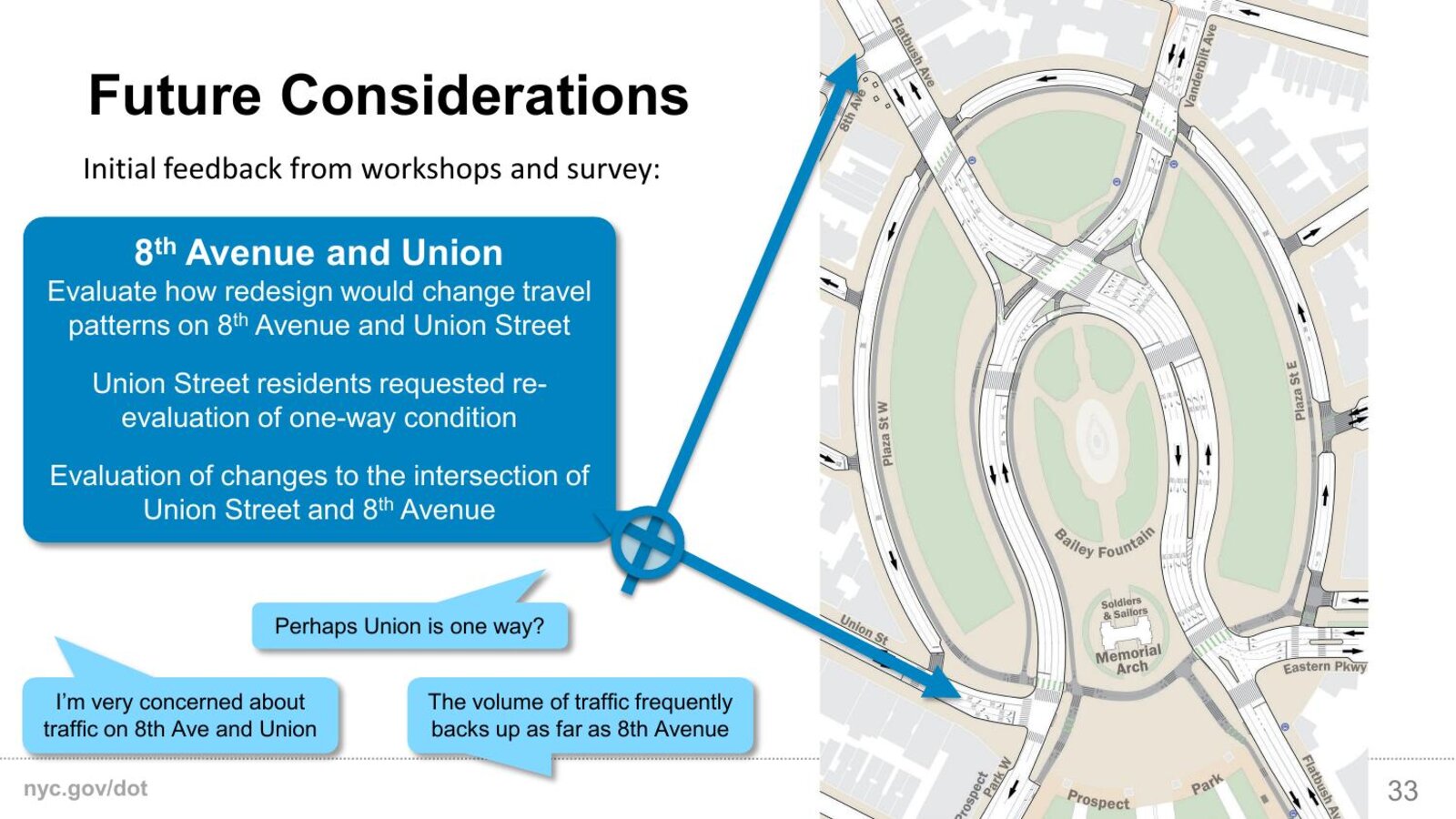
- 8th Avenue and Union Street — re-evaluate the one-way condition that Union Street residents flagged, and assess how the redesign would change travel patterns and the Union/8th intersection.
- 8th Avenue and St John’s Place — coordinate with adjacent buildings on operations, drop-off, and emergency-vehicle access; explore signal-timing improvements.
- Flatbush and Vanderbilt — identify ways to shorten crossings or add refuges where crosswalks feel long and exposed.
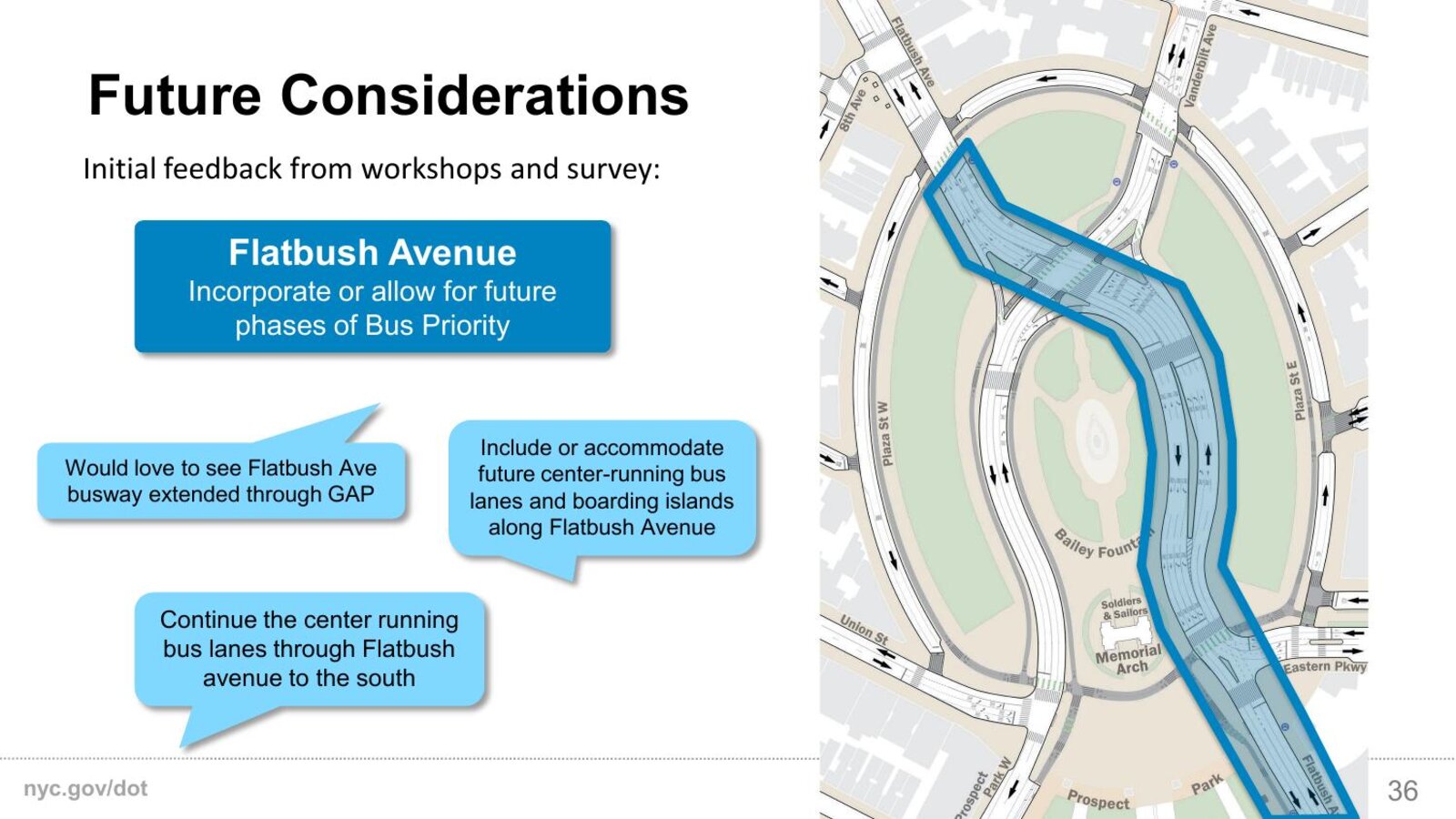
- Flatbush Avenue — incorporate or allow for future center-running bus lanes and boarding islands, including extending busway-style treatment south of the plaza.
- Park Entrance — define pedestrian vs. bicycle space with plantings and clear markings to reduce conflicts on the busy paths into the park.
- Plaza Street — develop curb-management plans for delivery access and emergency-vehicle access, addressing concerns about doctors’ offices, residents with disabilities, double-parking school buses, and delivery trucks.
A representative resident comment from this section:
“I am concerned about the intersection at the north end of the plaza — care needs to be taken to make BOTH ends of the plaza safe and welcoming for pedestrians.”
The Flatbush slide is worth flagging on its own. DOT writes that Flatbush “can be adapted to accommodate future Bus Priority Infrastructure south of the current project area,” and the resident comments push for exactly that:
“Would love to see Flatbush Ave busway extended through GAP.” “Include or accommodate future center-running bus lanes and boarding islands along Flatbush Avenue.”
The Avenues — Phase II
The deck also confirms that the Vanderbilt and Underhill avenue work moves to a second phase of the study. From the 2024 outreach:
- Vanderbilt Ave: 55% of respondents selected a Plaza block at least once; respondents concentrated plaza blocks in the middle of the corridor near restaurants and shops, with two-way traffic kept at the ends to maintain access to surrounding arteries.
- Underhill Ave: 61% selected a Plaza block at least once; key plaza blocks were placed at the James Forten Playground and Lowery Triangle.
Phase II will be coordinated with the broader AAMUP (Atlantic Ave Mixed-Use Plan) projects, including Atlantic Avenue and Dean/Bergen, in Summer 2026.
What’s next
Per the deck’s final slide:
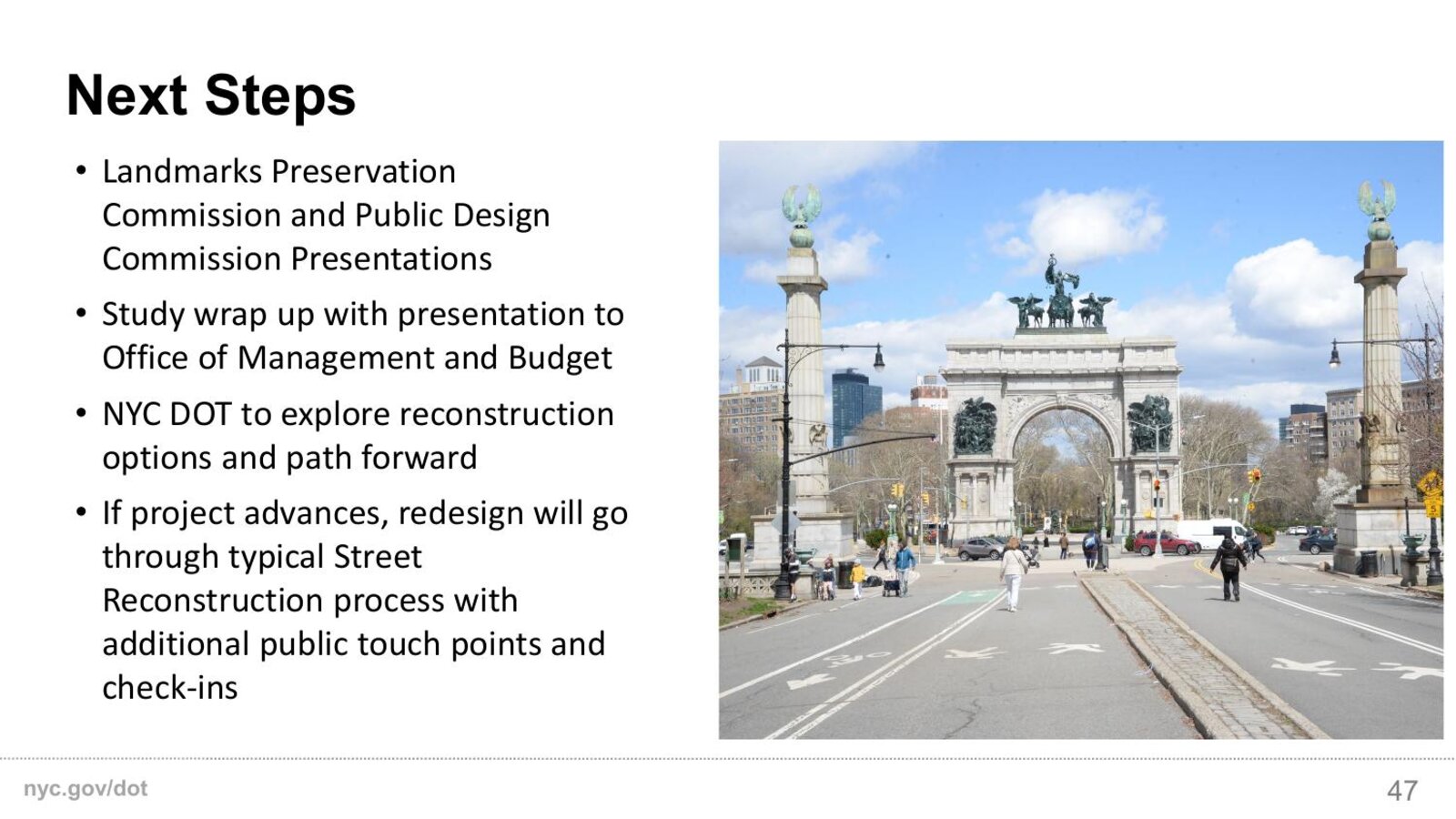
- Landmarks Preservation Commission and Public Design Commission presentations
- Study wrap-up with a presentation to the Office of Management and Budget
- NYC DOT to explore reconstruction options and a path forward
- “If project advances, redesign will go through typical Street Reconstruction process with additional public touch points and check-ins”
In other words: the public-input phase of the conceptual study is wrapping up. Next come the design-review commissions and the budget conversation that decide whether this gets built — and on what schedule.
Read it yourself
- NYC DOT — Grand Army Plaza Community Update, June 2026 (PDF, 48 pages)
- NYC DOT Grand Army Plaza project page — official source for future workshops and review milestones
Take action
The next decisions get made in design-review commissions and at OMB — not in another public survey. Keep the pressure on:
- Sign the petition → — every name strengthens the case that this is the design Brooklyn wants built, on schedule.
- Join the TA #SaferGrandArmy campaign — secondary CTA from our partners at Transportation Alternatives.