Bloomberg CityLab on the twenty-year fight for Grand Army Plaza
Bloomberg CityLab’s John Surico has a long piece on Grand Army Plaza that does something most coverage hasn’t: it treats the redesign as the latest chapter in a twenty-year campaign rather than a thing that started in April. It also lands the interview we’ve been waiting for — DOT Commissioner Mike Flynn, who was in the room when this started.
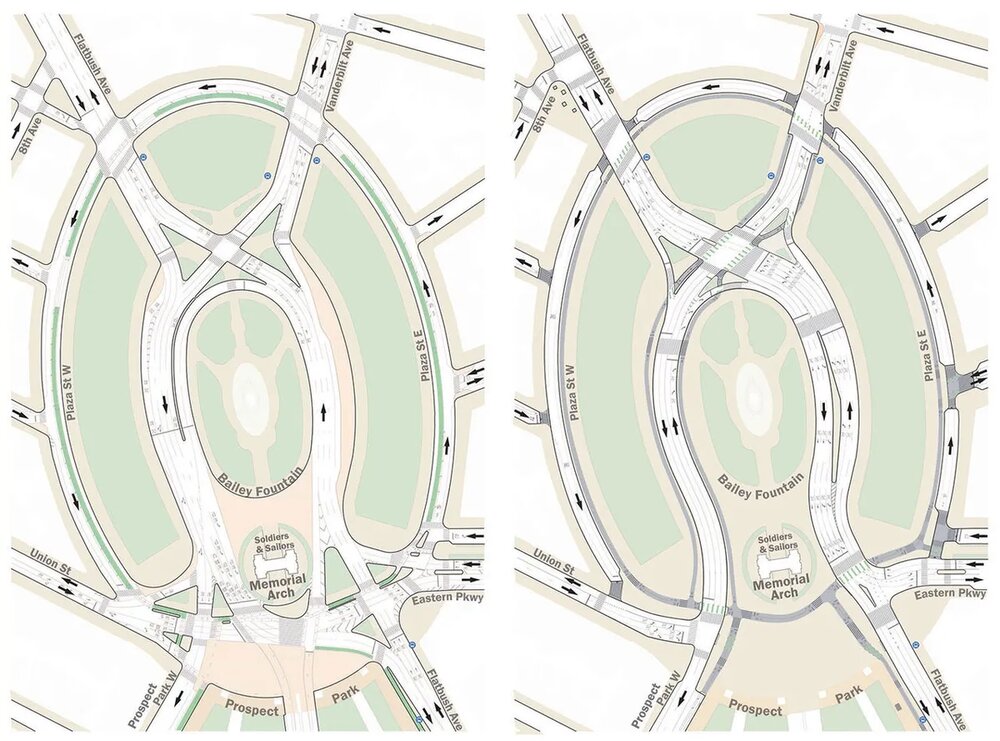
The Death-O-Meter, again
Surico opens the history section where we always end up:
“As soon as cars came into Grand Army Plaza, the space grew contentious. In the 1920s, with road fatalities spiking, safety advocates installed a ‘Death-O-Meter’ there to remind drivers and pedestrians alike of the plaza’s perils.”
The piece runs a remarkable late-1920s aerial — the plaza ringed with Model Ts, trolley wires overhead, and the “SLOW UP” Death-O-Meter sign planted in the middle of the oval. It’s worth clicking through for (the photo is licensed from Underwood Archives, so we can’t republish it here).
We’ve been keeping a file on this sign: it’s in our historical voices section, and the Stuyvesant Spectator built a whole piece around it in February. The plaza has been documented as dangerous for a century. The current number: 219 people injured between 2020 and 2025.
GAPCo gets its due
The best thing about the piece is how much room it gives the Grand Army Plaza Coalition, formed in 2006 — the design charrettes, the walking tours led by Jan Gehl, the digging through historical photographs of the plaza before cars.
We wrote about this last month, when a 2007 Streetfilm resurfaced showing GAPCo’s Robert Witherwax and a young Council Member Letitia James at exactly that workshop. Surico’s account and that film are the same story from two angles, twenty years apart. The Plan timeline has the full sequence.
And the throughline that makes this campaign unusual — the person running DOT was one of those volunteers:
“One of my final projects in class, I actually looked at Grand Army Plaza, which is really, in some ways, the beating heart of Brooklyn,” said Flynn. “This is a cultural and civic crossroads. It’s such an important location, yet it feels so disjointed.”
Flynn was a Pratt grad student then. He was also at DOT for the 2011 round of improvements:
“I just remember the excitement. Because the potential was huge, but the challenges were substantial.”
We flagged Flynn’s GAPCo history when Mamdani announced the plan in April.
What’s actually still open
Two useful specifics for anyone tracking whether this gets built:
The timeline and budget aren’t set. DOT told Bloomberg that another round of workshops recently concluded and that they’ll “start to scope out the budget and next steps for the capital construction project soon.” That is the fight now — not whether the design is right, but whether it gets funded and scheduled.
The bus plan collides with it. July’s Next Stop: Fast Buses, Better Service — the Mamdani administration’s blueprint for speeding up the country’s slowest buses — names Flatbush Avenue as one of five rapid bus corridors, with a center-running bus lane — running straight through the plaza. How the public-space project and the bus project fit together is, per DOT, still being worked out.
The critique from the other direction
Most opposition coverage focuses on drivers. Surico also quotes urban planner Annie Weinstock, whose objection is that the plan is too timid:
“I just worry that we’re chipping away at the margins with a plan that doesn’t meet the moment to make Grand Army Plaza a usable space. I’m just not sure how many people will choose to be that close to fast-moving traffic.”
Weinstock made the detailed version of this case in a 2024 piece that’s worth reading in full. She’s for the redesign — she calls it “exciting,” and says “if actually gets built, it would be huge” — but lists four things she’d change. The sharpest:
“The most glaring issue with Option B is the continued presence of the southbound segment of the western side of the inner traffic circle… the southbound section is entirely redundant… It is merely a shortcut for drivers, which flies in the face of the stated goals of this project.”
Her other three: extend Flatbush bus priority through the plaza with center-running lanes; add midblock crossings and open paths through the berms so people coming from St. John’s Place or Berkeley Place aren’t walking blocks out of their way; and give bikes a real north-south connection — possibly by handing that redundant car lane to cyclists. “Surely bikes need that shortcut more than cars.”
Worth noting she called for center-running Flatbush bus lanes through the plaza in 2024, two years before the bus blueprint proposed them.
Jon Orcutt of Bike New York, who was DOT policy director during the 2011 changes, makes the same point about ambition from experience:
“I don’t think we took a lot of traffic capacity out of the space with that effort.”
“Big public spaces like this, which will be massively popular if they’re accessible, are not the places to compromise.”
The strongest argument in the piece is the one it makes structurally: the case for this redesign has been made continuously since 2006, by the same neighbors, with the same evidence. What’s different now is a mayor behind it and a commissioner who helped write the original proposal. What’s missing is a budget line and a date.
- Sign the petition → — the design phase is done arguing about what. The fight now is when and funded.
- Join the TA #SaferGrandArmy campaign — our partners at Transportation Alternatives.
Source: Bloomberg CityLab, “Can Brooklyn’s Grand Army Plaza Finally Be Tamed?” by John Surico, July 29, 2026.